Find out more about the Roma.
• The Globe and Mail: The Next Stop for the Roma
• SALTO Youth
• Council of Europe: Route of Roma Culture and Heritage
• National Film Board of Canada: Opre Roma
 |
 |

In Europe, the Roma have a long history of persecution. In a region located in what is now Romania, they were enslaved for over 500 years, until 1863. Later, during World War II, the Nazis sent hundreds of thousands of Roma to concentration camps and between 200 000 and 800 000 were killed. Today, some Roma are a part of local communities, while others are isolated and are poorly educated and struggle to get by. To counter this reality, a group of 12 European countries have declared 2005–2015 to be the “Decade of Roma Inclusion.”
|
|
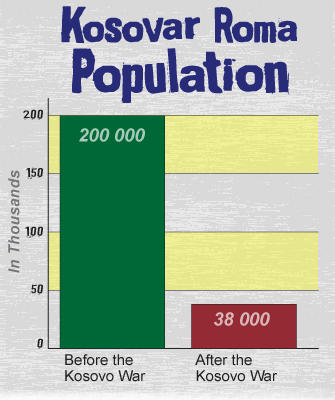
Source: Estimates from the UN Refugee Agency |
Like Ifran in Germany, the majority of displaced Roma went to neighbouring countries, and many to Western Europe. But these new homes are not always welcoming. Many Kosovar Roma in Western Europe are given only temporary permits instead of refugee status. In Germany, these permits are called duldung, or “toleration permits.”
 When the government considers it safe to send them back, they can be deported. (Temporary permits were the solution Western European countries developed to handle the large influx of Roma refugees.)
In fact, by April 2010, over 2000 Roma, Ashkali, and Egyptians had been deported back to Kosovo—many of them from Germany, Switzerland, and Sweden. This, despite the Office of the United Nations High Commissioner for Refugees calling on states not to deport Kosovar Albanians or Serbs to areas in the region where they would be in a minority, and not to deport Roma to Kosovo at all. Human rights groups, such as Amnesty International and Human Rights Watch, are concerned that these deportations could be considered refoulement. This means to return someone to face a real risk of persecution, and it’s prohibited under the UN Refugee Convention.
What awaits the Roma who are sent back? They face a risk of violent reprisals and many don’t have access to employment, health care, social welfare, and property. Many Kosovar Roma don’t have identity documents, because they lost them when they fled the violence, or they were never registered. (According to Human Rights Watch, a large proportion of Roma, Ashkali, and Egyptian women give birth outside hospitals. As a result, their children lack birth certificates, a document needed to obtain identity papers in Kosovo.)
The Roma living in today’s Kosovo are on the fringes of local communities. And the stereotype of the wandering gypsies doesn’t do them any good. Sani Rifati is a Romani activist who grew up in Kosovo. He’s the founder of Voice of Roma, a California-based non-profit group that advocates for Roma in Kosovo and Romani refugees around the world. When Rifati returned to the region several years after the war, he was appalled at the conditions in Roma camps for displaced people. One aid worker claimed that the “gypsies” didn’t need help—that they could manage on their own. They were nomads, after all, he argued.
“In Kosovo,” Rifati writes, “Roma have lived in houses for over seven hundred years, and most of them have never seen a wanderer’s caravan. The effect of such stereotypes is to dehumanize the Roma and destroy their cultural infrastructure.”
Neither Here Nor There
Although the Universal Declaration of Human Rights specifies that “everyone has the right to a nationality,” it seems the Kosovar Roma are going without that right. They are caught between temporary “toleration permits” in other countries and no papers in Kosovo. Many are living in a condition of de jure statelessness where they are not considered as nationals under the laws of any country, or de facto statelessness where they have a nationality, but the nationality is ineffective. According to the Office of the United Nations High Commissioner on Refugees, a good example of this is when a person is in practice denied rights which are enjoyed by all nationals, such as the right to return to the country and reside there.
For the Roma, who are spread out across Europe, statelessness
is often a concern. One Romani man from Kosovo lamented:
“Serbia doesn’t want to accept us. There is no peace in Kosovo.
We should go find our own state, but we don’t have one.”



 |
|
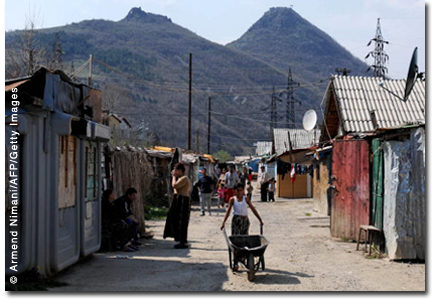
| A Roma refugee camp in Mitrovica, Kosovo. | |