 by Laura Peetoom,
 from notes by Lee Ann Uong
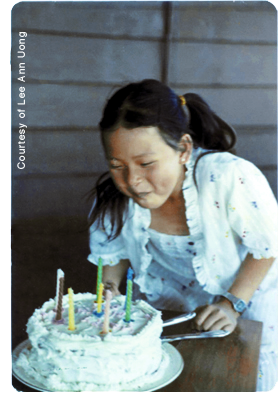
Lee Ann Uong was born Thu To Uong on August 12, 1974, the daughter of Chiu Chow Chinese living in Ben Tre, Vietnam. After the war between South and North Vietnam, her parents decided to leave. Tens of thousands of others were doing the same, fleeing years of war and political unrest in Southeast Asia. In January, 1979, the family boarded a ship called Skyluck, joining more than 2500 other refugees.
Hong Kong port police discovered the ship in early February, but didn’t allow it to approach the docks. Hong Kong was already struggling to accommodate the thousands of “boat people” that were landing on their shores and filling the camps set up to hold them. At the end of June, however, the Skyluck’s anchor cable was severed, the ship drifted in and crashed ashore, and Hong Kong authorities were forced to accept the refugees.
Over the next half year, Lee Ann’s family lived in several camps, waiting for their name to be drawn in a sort of refugee exit lottery. Relatives—grandparents, uncles, an aunt—had chosen to go to Australia or England. Lee Ann’s parents chose Canada. Though they didn’t know it at the time, Canada had begun a unique program, in which private citizens could sponsor Southeast Asian “boat people,” bringing them to Canada and supporting them for up to a year.
Lee Ann, her parents, and her three brothers came to Canada by air, arriving in Edmonton, Alberta, in November 1979. After spending some time in a military barracks, they moved to Camrose, where their sponsors (about six families, part of a larger group of 60 families) gave them a place to live, provided clothing and some income support, and helped Lee Ann’s parents find jobs. By the end of their fifth year in Canada, Lee Ann’s family owned the house they lived in. The sponsors admired the way they were settling in. They seemed a model family, hardworking and always happy.
Being young, Lee Ann took to English quickly, and (her brothers being unwilling to take on the job) she soon became an interpreter for her parents. By the end of Grade 4, she was excelling in every subject, and in Grade 5, she won the honours medal for top standing in her grade. Her teachers were supportive and her peers were friendly. She was good at sports and made many friends.
Well-meaning Canadians acquainted her academic progress with an Asian stereotype, which was underscored somewhat by the family’s public attitude. (Lee Ann and her brothers were reminded always to be respectful toward the sponsors and other Canadians in their Camrose community, so that everyone would know they were grateful for all they had been given.) But Lee Ann’s drive to succeed in school came entirely from within.
Back in Vietnam, Lee Ann had hardly seen her brothers and father—they had their lives, Lee Ann and her mother had another. In Canada, they were “a family of six strangers,” held together by their being newcomers in a strange land. When the family moved across the country, to Mississauga, Ontario, they stopped acting like “the perfect family.” The long hours her parents worked, the independent lives her brothers began leading as soon as they could, isolated Lee Ann in a new way. Conflicts arose: Lee Ann’s parents wanted her to be “more Chinese” and date only Chinese or Vietnamese boys. They were critical of her choices and her behaviour. Uncomfortable at home, Lee Ann invested more of her true self in school and with friends.
One friend, Helen, was born in Canada to Cantonese parents, and it was at her home that Lee Ann began to identify something crucial. While still in primary school, Lee Ann had noticed differences between her own and Canadian families: more playfulness, fewer chores, and the expectation that kids need to be kids. (By age eight, Lee Ann was cleaning house and cooking for the entire family.) Helen’s family maintained some of the Chinese traditional values, such as respect for elders and duty toward the family before yourself. But they also welcomed new, Canadian things, such as family vacations. Helen’s family was also affectionate, supportive, and mutually respectful. This, Lee Ann began to realize, was what she was missing at home, and it had nothing to do with being Chinese or Canadian.
Figuring out what is her own, what is her family, what is Chinese, and what is Canadian has been the work of a lifetime for Lee Ann. She remembers one point when everything came together in the most peculiar way:
After several survival jobs, I got a job with the Buy&Sell classified tabloids. The owner was English and his family and friends ran the business. They had started a Chinese Buy&Sell to capitalize on the influx of Chinese moving to Vancouver to escape the China takeover of Hong Kong. The paper was losing money the past five years, and out of desperation, they hired me to manage the newspaper because I am “Chinese”—even though I insisted that I only looked Chinese and did not speak Cantonese very well, or read or write any Chinese. That didn’t seem to matter. I was 21 years old and managing Chinese staff double my age from China and Hong Kong. The staff were traditional Chinese, openly spoke Chinese and only to each other, were prejudiced amongst themselves, and collectively segregated themselves from the “white people” in the company. Under my management, the Chinese Buy&Sell became the #1 free Chinese classified newspaper in Vancouver’s Chinese community, and a household name. Only in Canada can a Vietnamese-born Chinese be in charge and earn the respect of Chinese from Hong Kong and China, and all work together under one roof.
 |
 |